









Southeast Asia is home to 11 countries, each with its own national drug regulatory authority, submission requirements, and approval timelines. For pharmaceutical companies planning to bring products to the region, this diversity is one of the most significant factors shaping how quickly and predictably a product can reach patients.
Explore Southeast Asia’s pharmaceutical regulatory landscape, including approval timelines, local requirements and key considerations for market entry

Regulatory review timelines continue to vary across Southeast Asia, depending on product type, evaluation pathway, and the use of prior approvals from recognised authorities. To illustrate how these differences affect market entry planning, the table below compares requirements and published timelines across four key markets: Malaysia, Singapore, Indonesia and the Philippines.
A Snapshot of Drug Registration in Four Representative Markets
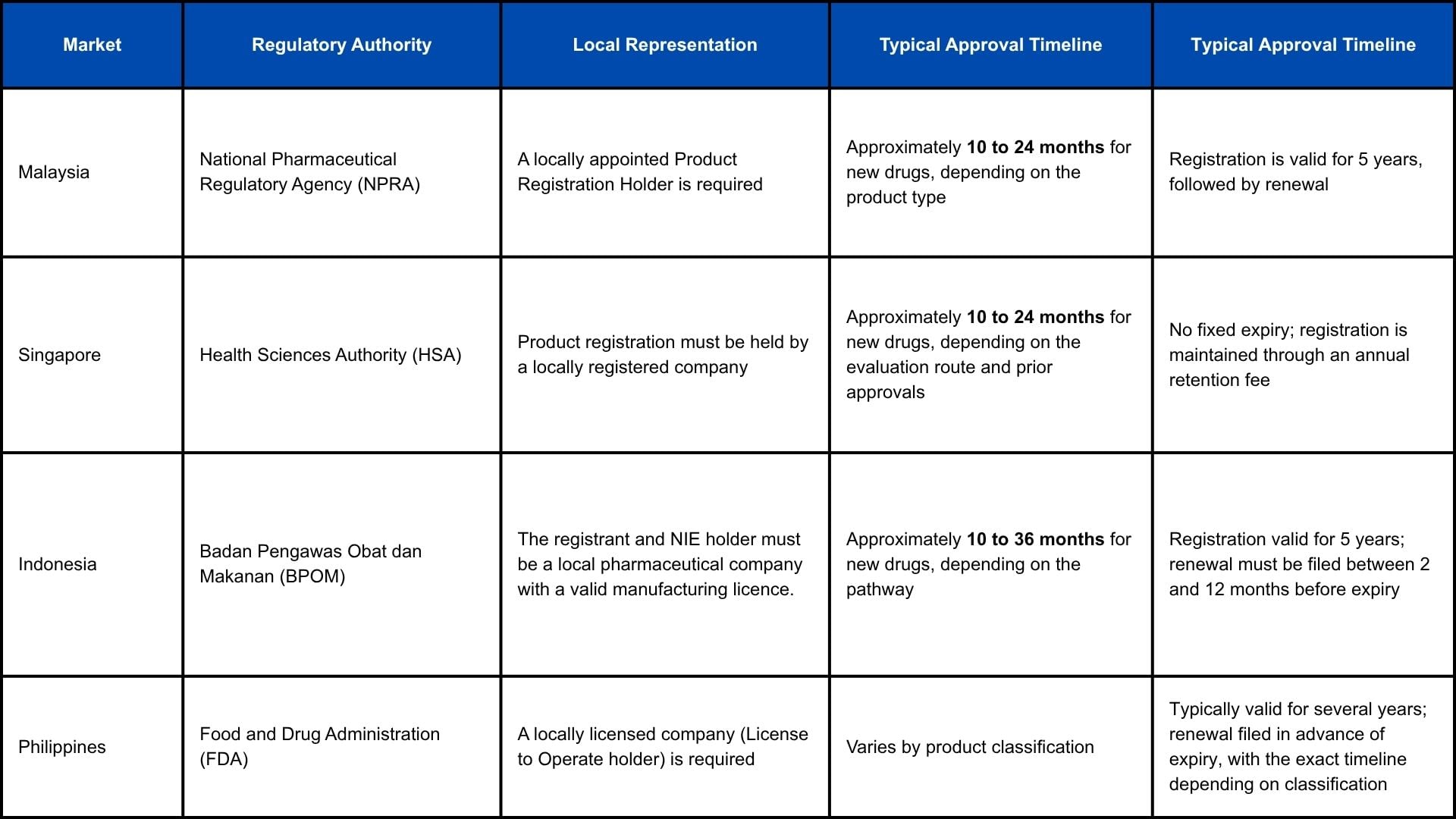
The timelines above are indicative and vary by product type, evaluation pathway, submission quality, and requests for additional information. Companies should confirm current requirements and timelines with each regulator or a qualified local partner before finalising a market entry plan.
Where Companies Commonly Encounter Friction
In every market shown above, and across most of the wider region, a locally registered entity, rather than the manufacturer itself, holds the registration and manages ongoing regulatory obligations.
Examples include Malaysia's stability data requirements for its tropical climate and Indonesia's requirement for Indonesian-language labelling.
Singapore's ongoing annual retention model operates quite differently from Malaysia's and Indonesia's fixed multi-year cycles.
Delays in responding to requests for additional information can materially extend the overall process, regardless of the market.
Southeast Asia's regulatory diversity, illustrated here by four representative markets, poses a genuine planning challenge for any pharmaceutical company entering the region. Understanding how registration authorities, requirements, and timelines vary enables a more realistic, better-sequenced approach to market entry, rather than treating Southeast Asia as a single, uniform process.
At EP Plus Group, we support companies across the Pharmaceuticals, Medical Aesthetics, Fertility Sciences, and Medical Nutrition sectors, drawing on established regulatory relationships and local representation throughout Southeast Asia. From initial registration to renewal, we help companies navigate each market's requirements as part of a coordinated regional strategy.
To learn more about how we support market entry across the region, visit www.epplusgroup.com or contact our team.
References:
1. National Pharmaceutical Regulatory Agency (NPRA), Malaysia
2. Health Sciences Authority (HSA), Singapore
3. Badan Pengawas Obat dan Makanan (BPOM), Indonesia
4. Food and Drug Administration (FDA), Philippines